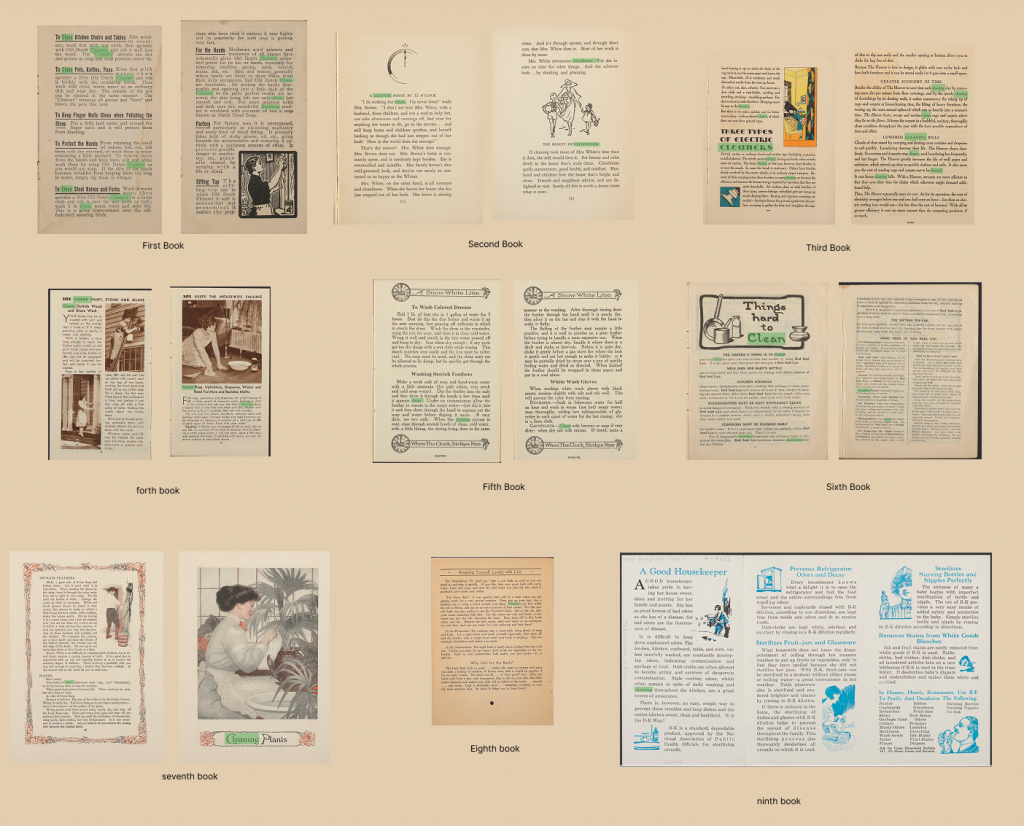
I selected the first 10 books from the “What Women Want to Know” special section in the Harvard Collection, specifically the “Clean” section. These 10 books were the result of industrialisation in the United States in the early 20th century and the Social Hygiene movement. They were the products of major commercial companies such as Procter & Gamble, etc., which deeply intertwined cleanliness with women or women’s marriages. As a result, they produced pseudo-scientific promotional materials for consumers, such as books and manuals. (Social hygiene movement, 2026)
Drawing on Michel Foucault’s viewpoint in “The Order of Things”, the establishment of “elemental systems” and “initial standards” (Foucault, 1989) is the foundation of any cataloging method. Therefore, in this project, I chose to designate “clean” as the “common center” of the classified information for this project (Foucault, 1989).
(Re )present
I chose to extract the word “clean”. Firstly, this is because throughout these 10 books, “clean” appears on every page of the book, as I have marked below. Moreover, from a historical perspective. Although in a physical sense, these “clean” books refer to disinfection, cleaning, or removing dirt. However, in the early 20th century, merchants transformed “clean” into a commercial means of idealizing modern life, and it was heavily tied to women’s marriages. Nevertheless, “clean” lies hidden within explanatory articles, so I extracted all the “clean” words I saw in this book, hoping to make the audience confront commercial brainwashing and social regulation directly.
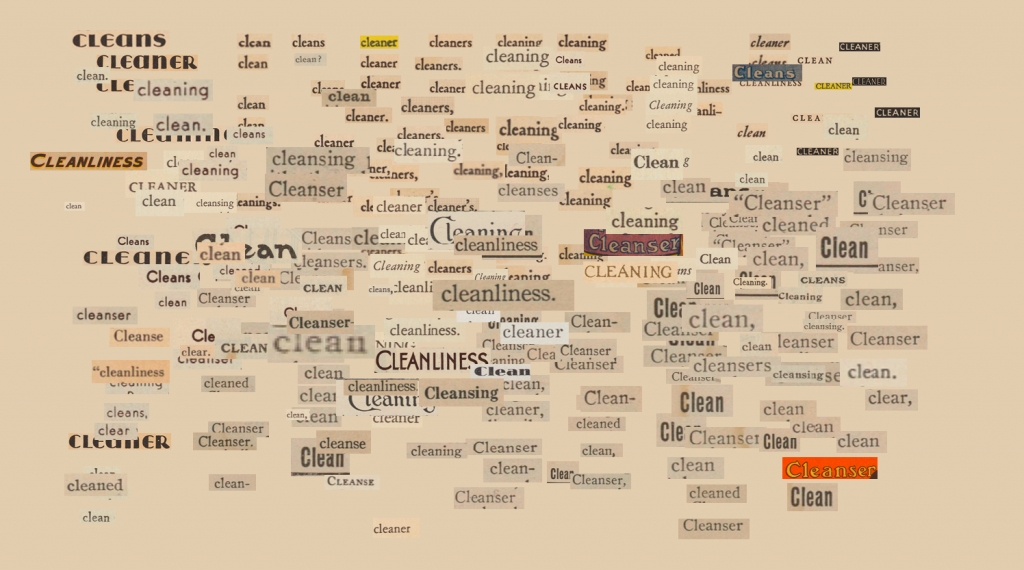
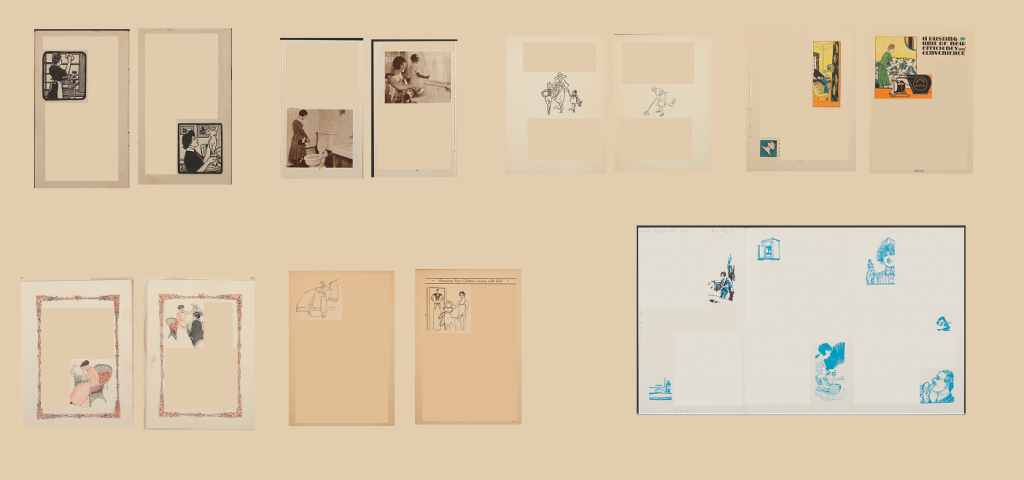
Since this is a book about cleaning, I will first select all the cleaning actions from these 10 books.
Taxonomising
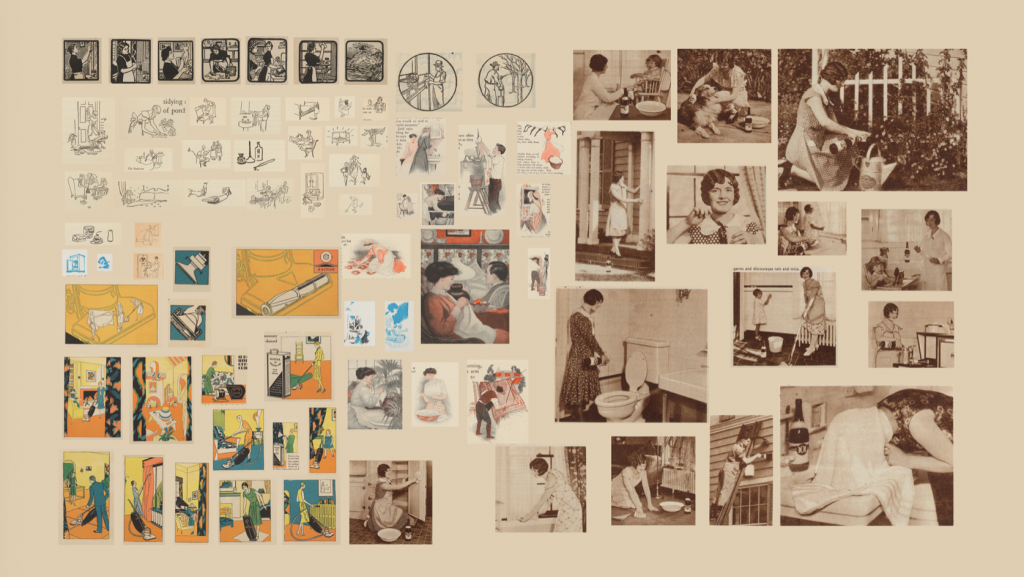
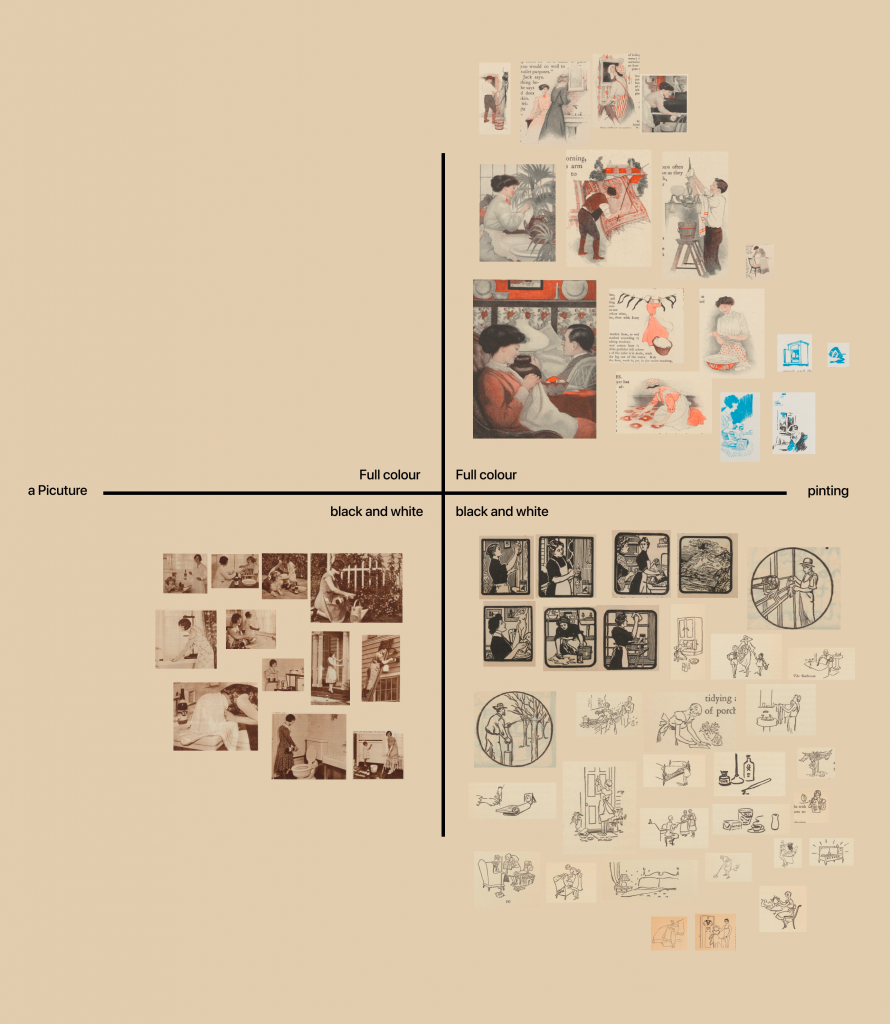
I will extract the collected photos into a coordinate system, which is a mathematical framework that uses one or more numbers (coordinates) to uniquely determine and standardise the position of points, lines, or shapes in a space. In other words, a coordinate system is not only for classification, but also establishes a spatial entity with measurement relationships. This function allows me to transform the originally scattered images into a directional and displaced visual map, visually revealing that this quadrant classification reveals how commercial marketing has gradually shifted from simple technical documents to highly stylized and colorful idealized family fantasies.
I found that they themselves are very regular in the book. These elements and the layout are all presented in a visual effect that shows a strict grid pattern, and they have an orderly sense. For example, they appear in the upper left corner or the lower right corner. To a certain extent, this showcases the core logic of commercial design in the 20th century.
Subverting
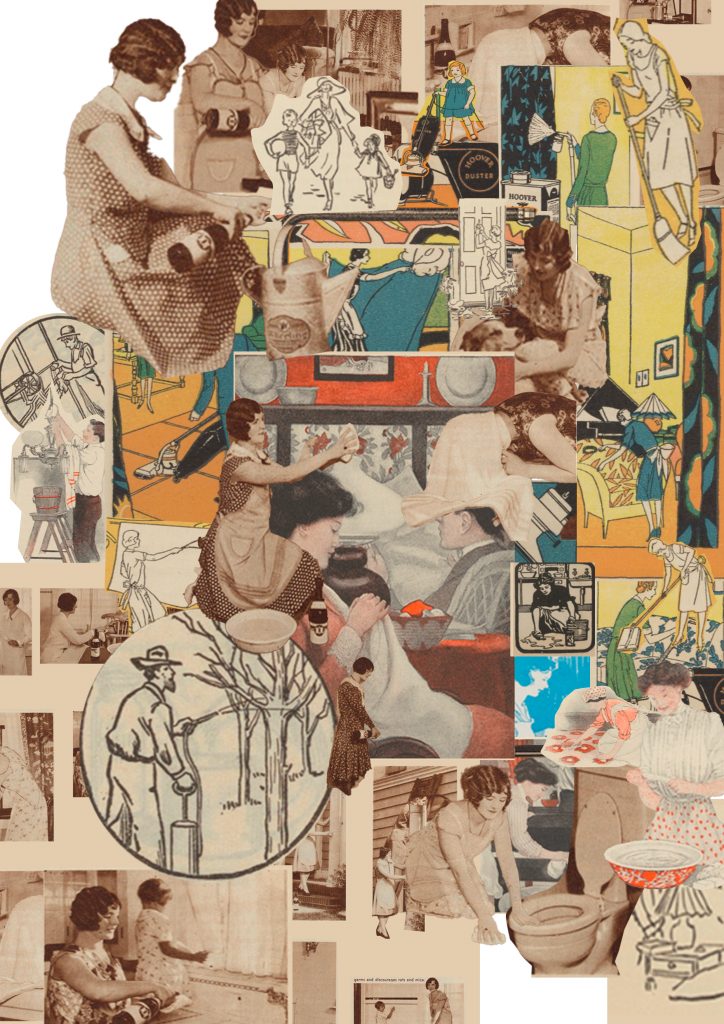
Therefore, I hope to use the method of “subverting”, but collage is a very good way to break through the core logic of such commercial designs. This is because the artists of Dadaism also used collage to tear apart the brainwashing of business models in the era of booming mass media. So although it is still within the information content brought by this book, I forcibly extracted the information I collected in this book, such as women cleaning toilets, women mopping floors, and women with children. This made people confront the sensory overload encountered behind such commercial values.
* Use Ai as a translation tool help me translate from Chinese to English
Reference
Michel Foucault, ‘Preface’, The Order of Things: An Archaeology of the Human Sciences, [1966] 1989
Social hygiene movement. (2026). In: Wikipedia. [online] Available at: https://en.wikipedia.org/w/index.php?title=Social_hygiene_movement&oldid=1371011097.
Leave a Reply