This time, I returned to this place again, collected the feedback from everyone during the course, and re-read the reference books. It is worth mentioning that during the previous observations, I was like an observer, observing the relationships between the people and the buildings here. This time, I chose to blend in and become part of the crowd, combine with observing from the outside. Based on my original drawings, I filled in this gap again through the use of brushes and notes, which gave me many new feelings and experiences.
Background
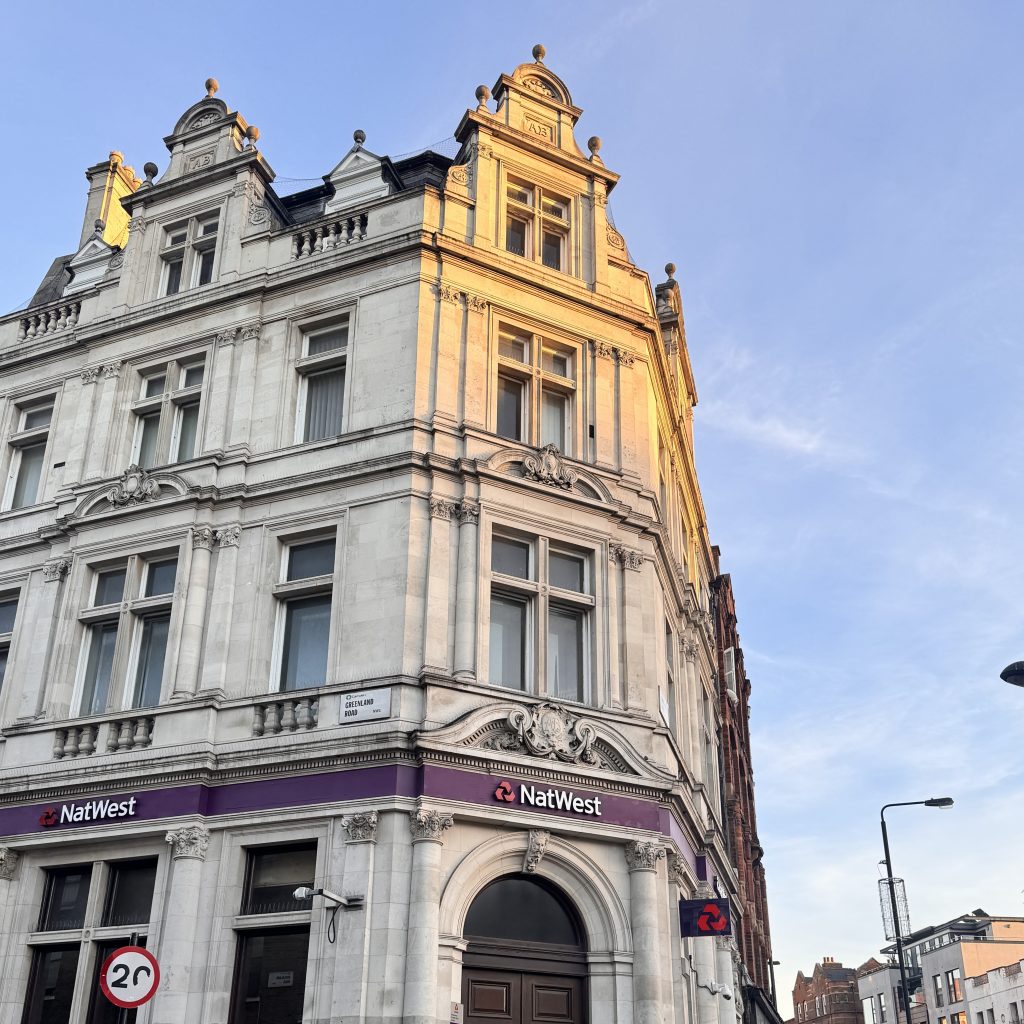
This study focuses on a crossroads in Camden Town, London. I chose this location because it was the first place I encountered in London under the bright neon lights of a noisy bar, where people were laughing and chatting, carrying with them new hopes and expectations, as well as my curiosity about this place. Secondly, this was also the place where I did my exciting shopping during my time in London. Here, one could purchase essential items for life such as food and daily necessities. There were numerous street-side stores along the street, namely bars, street markets, and souvenir shops. However, it is worth noting that such street-side stores are becoming increasingly rare in China, and people tend to prefer using large comprehensive shopping malls to buy their daily necessities in one place. Moreover, as I moved through this small crossroads, I could hear people using different languages, such as Chinese, Japanese, Spanish, English, and French. Moreover, the urban infrastructure here also differs significantly from that in China. For example, when waiting at the traffic lights, people can actively press this button to turn the green light on, and there is a safety island in the centre of the zebra crossing where people can communicate and determine their direction again, or wait for the green light to turn on again in a relatively safe position. However, such urban infrastructure and the flow of people speaking different languages are not found in China. So this made me think about whether I could further observe these people speaking different languages at this small crossroads, and how they use this urban infrastructure.
Mapping the site
In order to rectify the overlooked details from last week and to meet Max’s requirement of presenting this field through “drawing” method, I decided to further improve and add the map drawn last week to complete the entire research process. During the previous research, through a planar approach, I only recorded the paintings of the surrounding buildings from one direction. Therefore, I first chose to observe and draw the specific infrastructure such as buildings, streets, and traffic signal lights in this space from different angles.
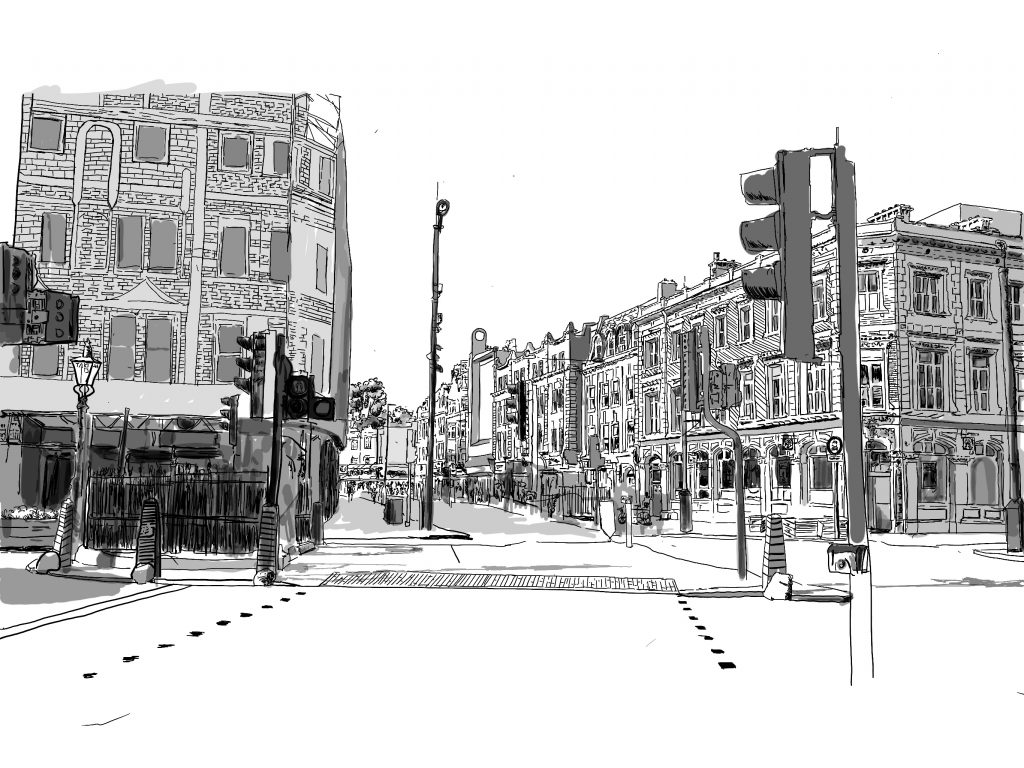
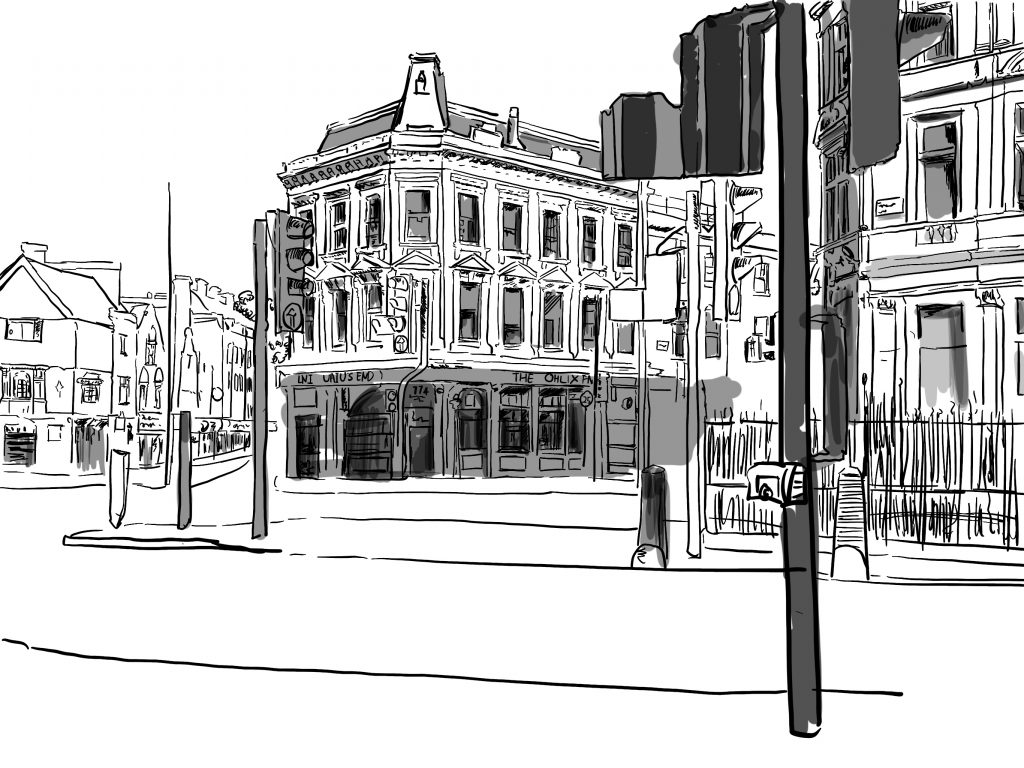
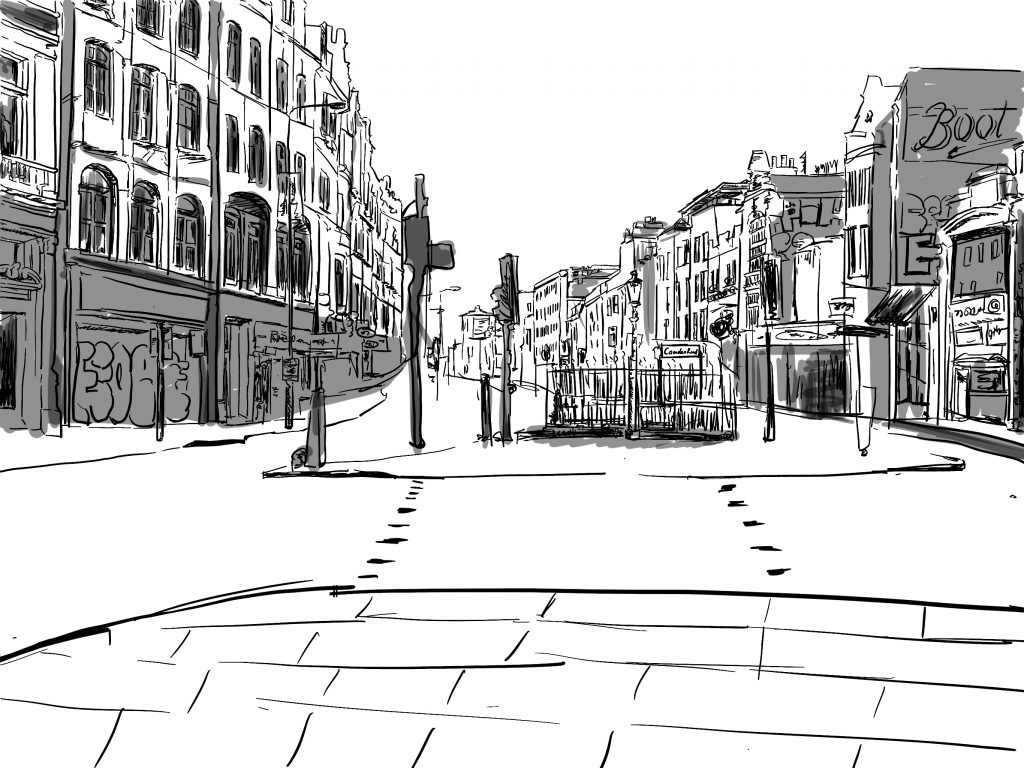
During the process of mapping, I discovered that the walking distance of pedestrians was relatively short, about 5- 6 seconds, and the time spent crossing this intersection was very brief. To ensure that no key details were missed, I adjusted the writing strategy without missing any information, as shown in Figure 1.1. I quickly wrote down the keywords on the spot, and then, during the intervals when no pedestrians passed, I would gradually add and refine these visual details one by one.
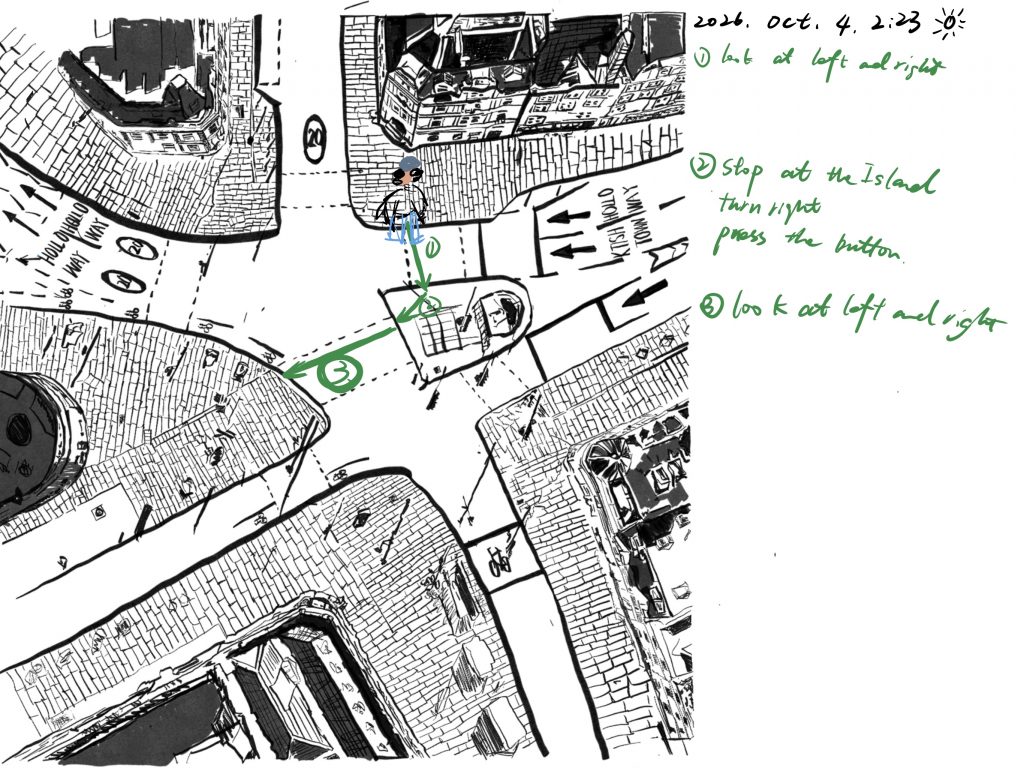
Below are the various samples of both individuals and vehicles we have recorded over the past few days, and their usage of this space. In order to ensure that this observation has a certain narrative quality, I chose to write down each person’s path as a diary, documenting their usage of this space, and I created a unique card for each person. I believe this can ensure that more information is not lost.
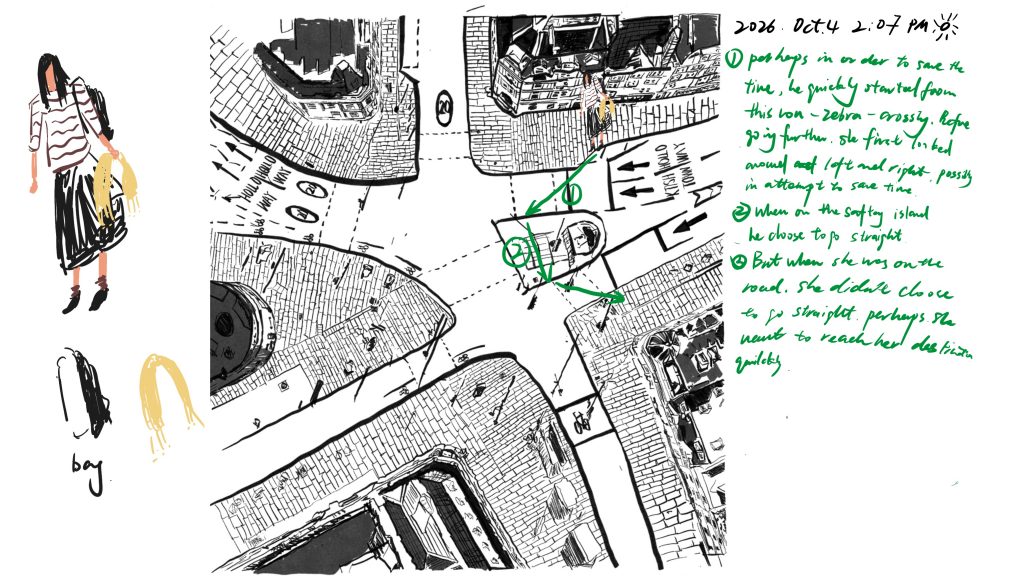
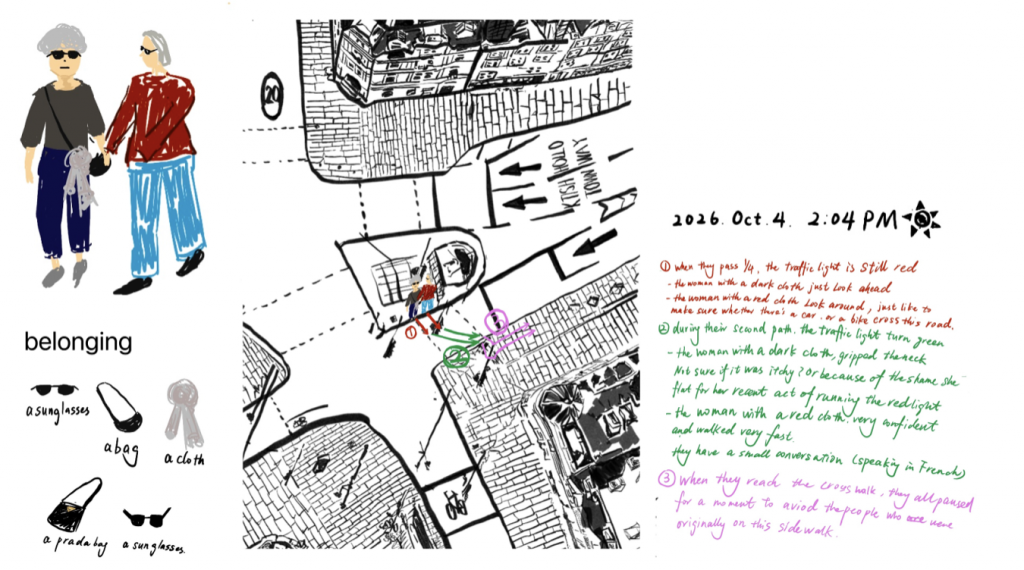
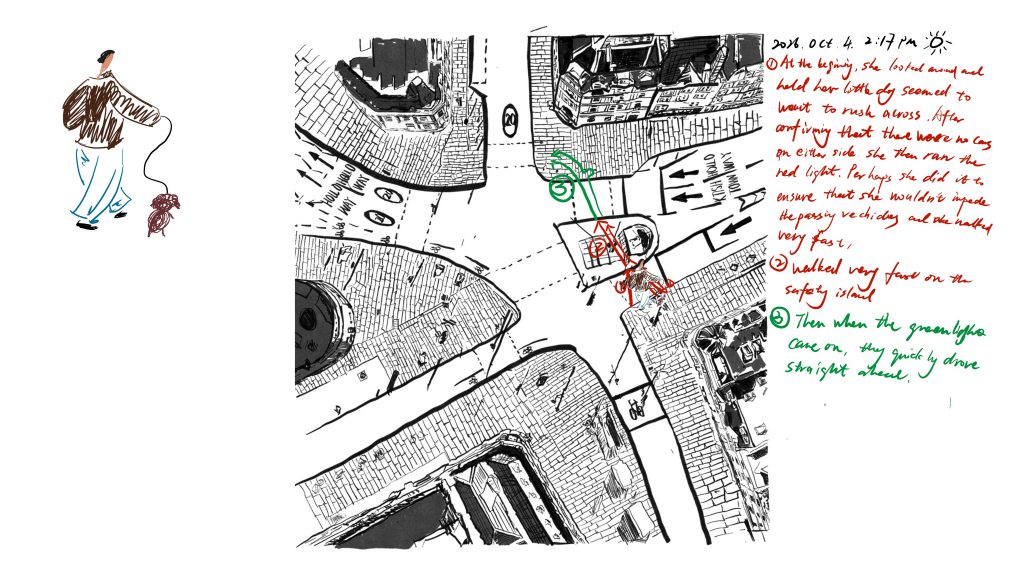
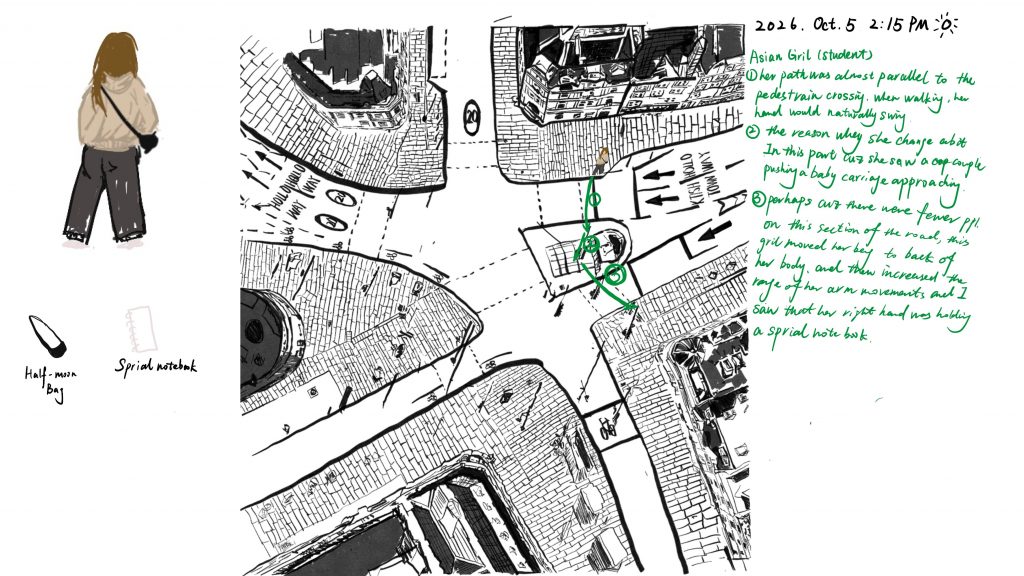
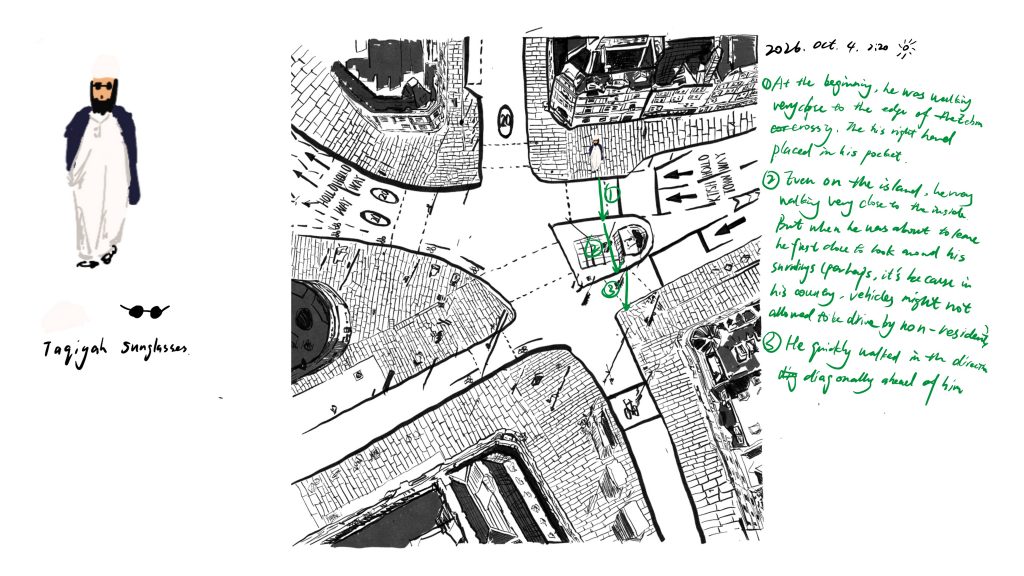
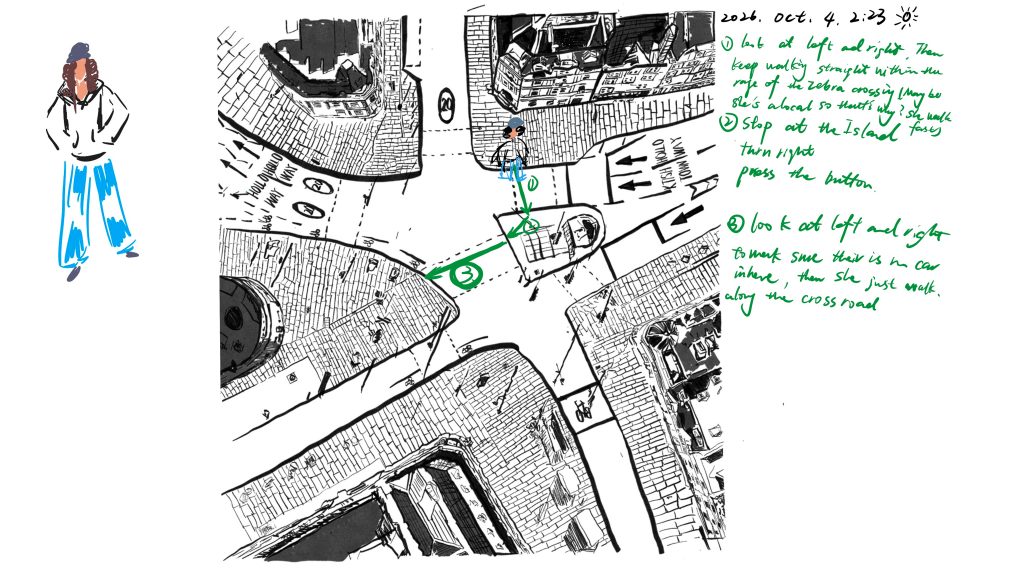
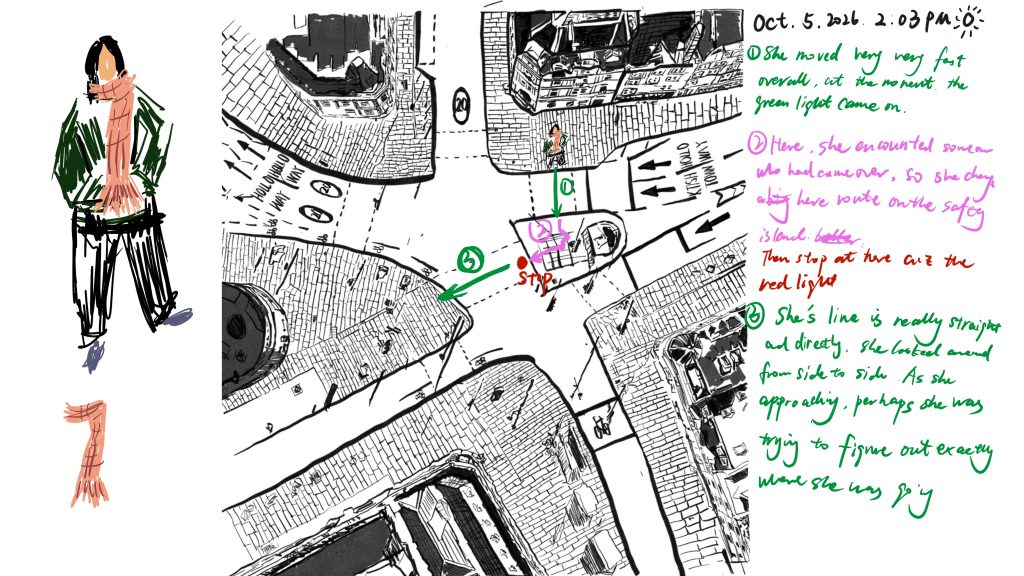
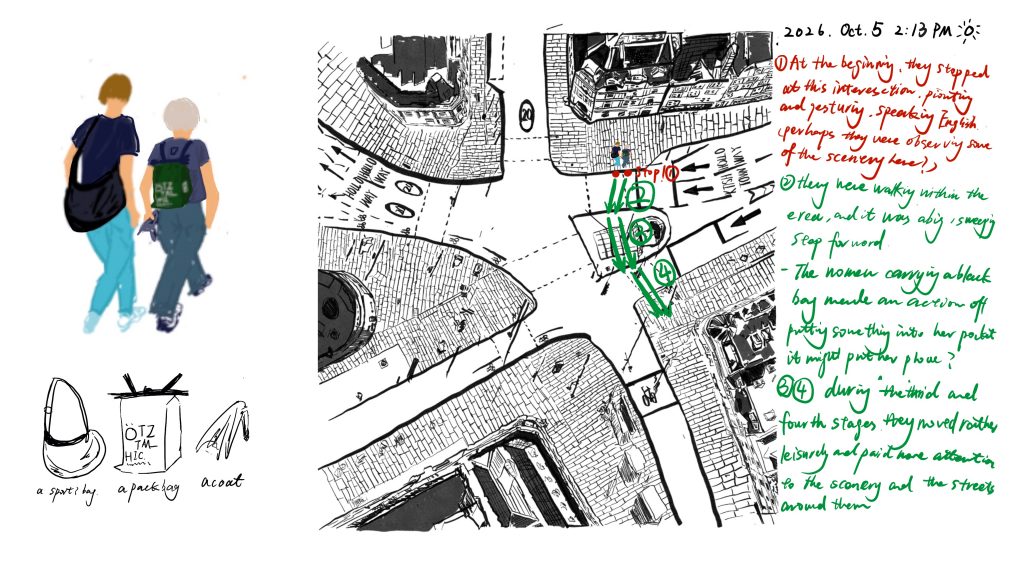
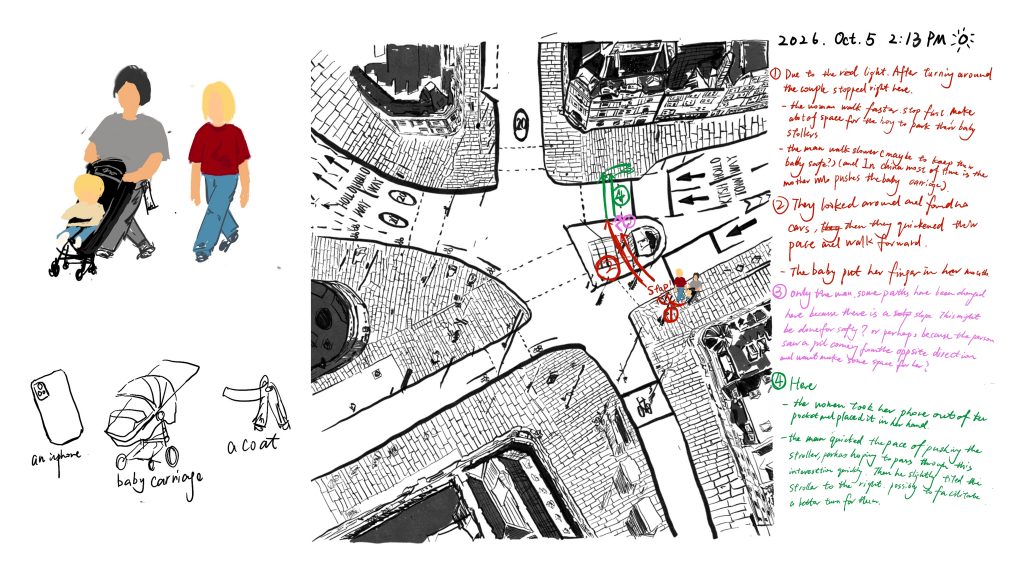
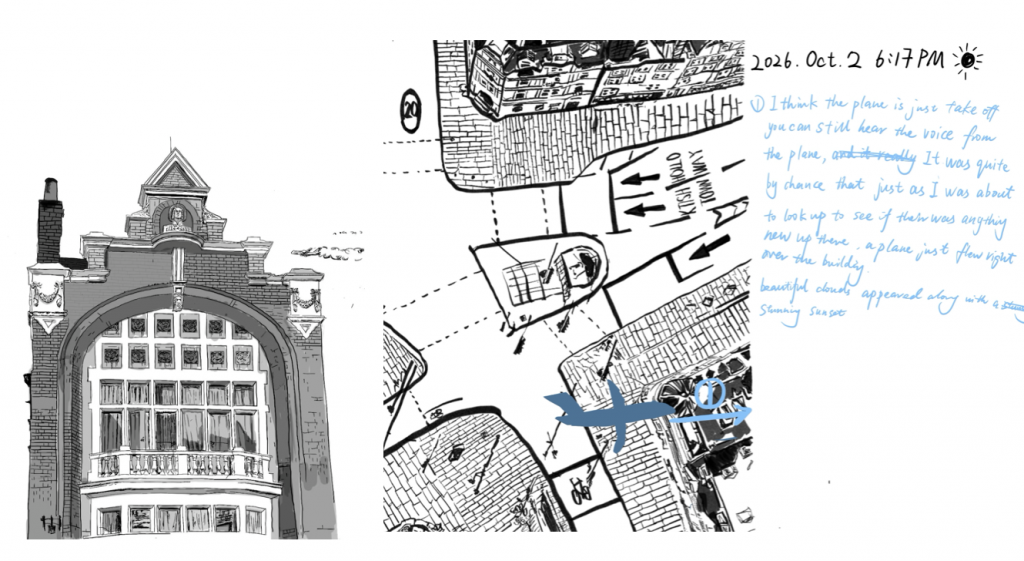
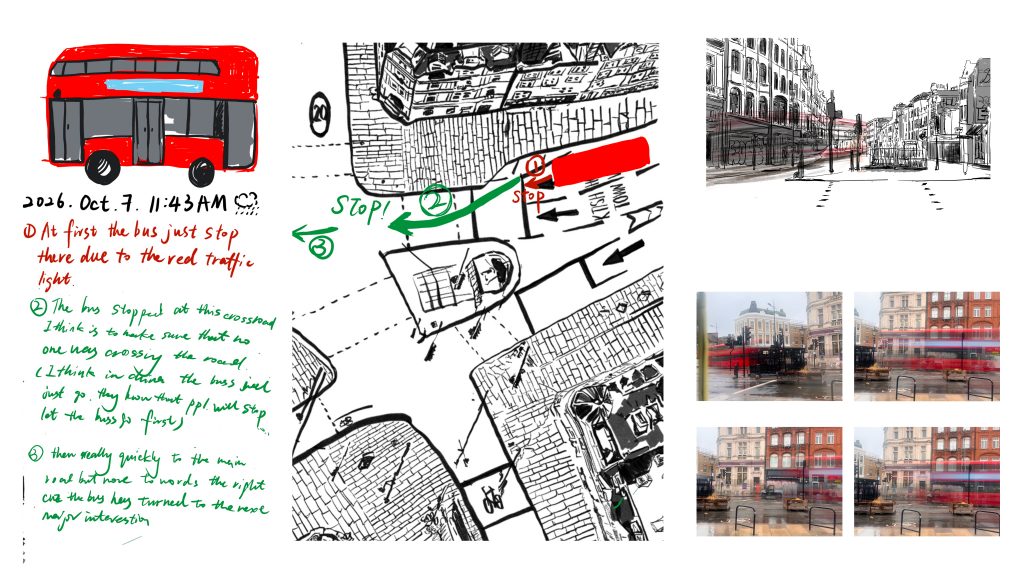
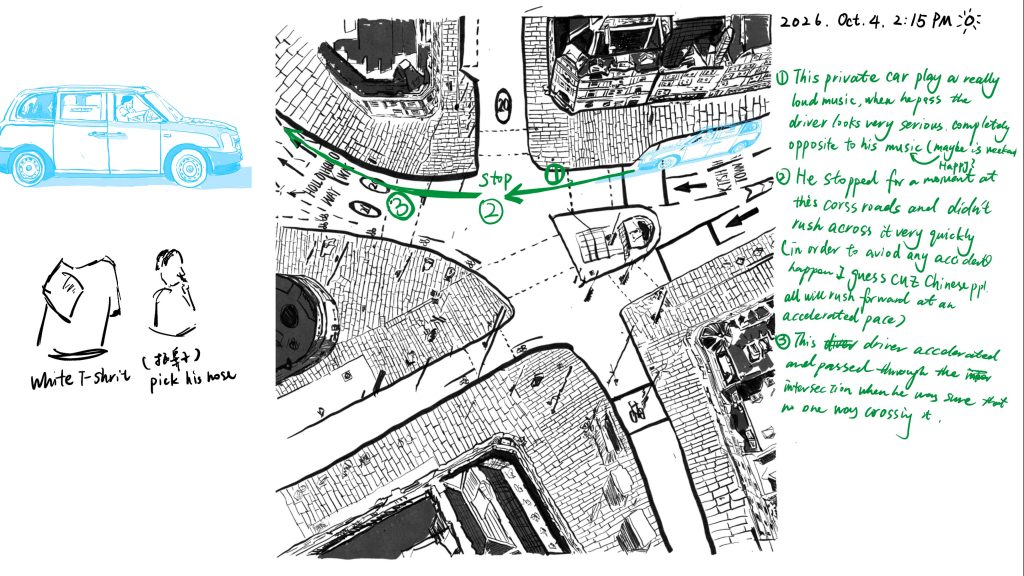
In fact, pedestrians always rush across the road, spending very little time there. Static paper images simply cannot fully capture the dynamic feeling of the oncoming vehicles. So I began to think: Could I solve this problem by having pedestrians move along with their original sounds on this route? Frame-by-frame animation perfectly breaks through the limitations of physical time: I can slow down the rhythm of the moment when people intersect when the green light is on, and also transform the one-minute intersection into a visually impactful rhythm, thereby recreating in visual language where I heard the sounds at that time. This not only perfectly responds to the suggestion made by my classmates in class last week to “inject real story elements into the space”, but also because the animation is based on the original drawings I made, it is both experimental and can well retain the painting texture I have always adhered to.
In terms of sound collection, to ensure that the recording can accurately reproduce the subtle experiences of a specific pedestrian rather than the noise in a chaotic environment, I invited a friend to accompany and participate in the recording. Because intersections not only have visual elements but also sounds – the beeping of traffic lights, the friction of shoes on the ground, scattered conversations. And if only using a simple map, it is impossible to well express the situation where people simultaneously enter when there are no cars during the green light, forcing people to change their paths.
Feedback
Clearly define the core approach and avoid being too scattered
I have tried various methods such as hand-drawn maps, animations, observation notes, trajectory analysis, etc. Although each clue is interesting, the supervisor suggests that you choose only one core approach (Focus on one method) and keep repeating and deepening it. This way, the final presentation will have greater impact.
Deepen the “hand-drawn + animation + sound” approach. The supervisor strongly recommends that you focus on “street drawings” and the combination of animation and sound, and pointed out specific improvement directions: Explore the “selectivity” and “functionality” of animation: Animation is not just for “making things move”, but is used to guide the viewer’s line of sight and auditory perception (creating “selective hearing”). The animation does not necessarily need to be complex for the entire picture. You can keep the static background and only animate the very detailed parts (such as a flying bird, garbage in the wind, passing pedestrians/vehicles/airplanes). I can try zooming in on certain local details or directly use static images combined with the original soundtrack (Soundtrack), without insisting on full animation.
Experiment with different frame rates (Frame Rate): The current animation looks very detailed and very time-consuming. The supervisor suggests that you try changing the frame rate (for example, using a simple 2-frame loop animation).Changing the frame rate can not only help you save production time, but also create different visual rhythms, influencing what the audience “can see and ignore”, which can become part of your research methodology (Research Methodology). Deepen “animating sound”: Further explore “how visual effects/animation help us interpret the noise and sounds in a space”. Express what your eyes see and ears hear (the combination of vision and hearing) through concise detail animations.
Self reflection:
I feel that throughout the process, I might have been trying to avoid excessive divergent thinking and instead focus on one thing. From this perspective, we can then explore some new possibilities.
Leave a Reply